By Gavin Hewitson, founder of In-box
If you sell on Amazon and on your own Shopify store, you already know the trade-off. Amazon brings the volume, but the customer belongs to Amazon. Your own store is where you can build a relationship, and email is how you do it.
The catch is that most brands run email like a discount machine. Every email has a code, margins take a big hit during peak sales, and customers learn to wait for the next offer.
At In-box, we've worked with more than 500 ecommerce brands on email and SMS, and the profitable programmes are all more selective about offering discounts. Here's what they do instead:
1. Build the list on your own store
An Amazon purchase doesn't give you permission to email a buyer. Your list has to be built on your own site, which makes your sign-up forms the starting point.
Three rules matter most:
- Ask for email only on the first form. When brands ask for a phone number straight after an email address, it makes 25% to 45% of people close the form before they see their discount, even when the field is optional.
- Show the discount code on the final step and make the button automatically apply it at checkout, so shoppers don't need to leave your site to find the code.
- Ask what they're shopping for on a second step. For a jewellery brand, that might be engagement rings, wedding bands, or necklaces. Their answer will send them down a matching welcome series.
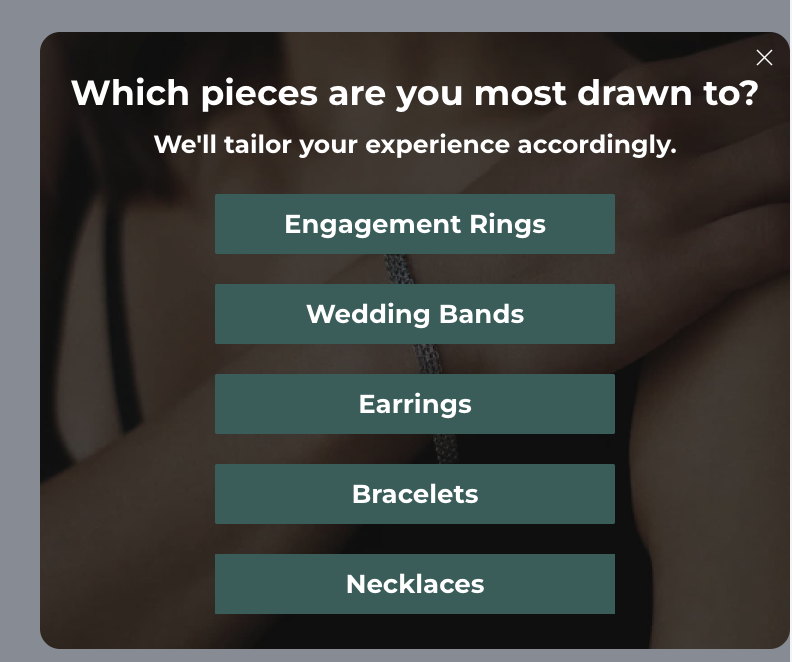
One client store doing about $3 million a month runs eight forms this way, including a second flyout on product and cart pages that picked up about 2,300 subscribers the main pop-up had missed. We go into more detail in what an eight-figure store's sign-up form setup looks like.
2. Give the discount to non-buyers only
Split every campaign and every flow into two groups: people who have bought from your store before and people who haven't. Put the welcome offer for non-buyers in every email until they use it. You don’t have to give previous buyers a code at all.
Across our accounts, roughly 80% of campaign revenue comes from people who have already bought. In one eight-figure account, a single campaign made $7,262 from past buyers and $640 from non-buyers. Your repeat customers don't need a discount to buy again, but your first-time buyers might need a reason to try you.
3. Replace codes with price drops at peak
Michael Gabriels, a lab-grown diamond jewellery brand, relied on 25% to 30% discount codes that squeezed margin during major sales. For Valentine's Day 2026, we switched to smaller product-level price drops instead.
Discount code usage fell 67%, while Valentine's Day 2026 attributed sales still rose 441%. Over Black Friday Cyber Monday 2025, orders grew from 324 to 3,393. Average open rates reached 57%, and email held at about 30% of revenue while the business scaled 8x.
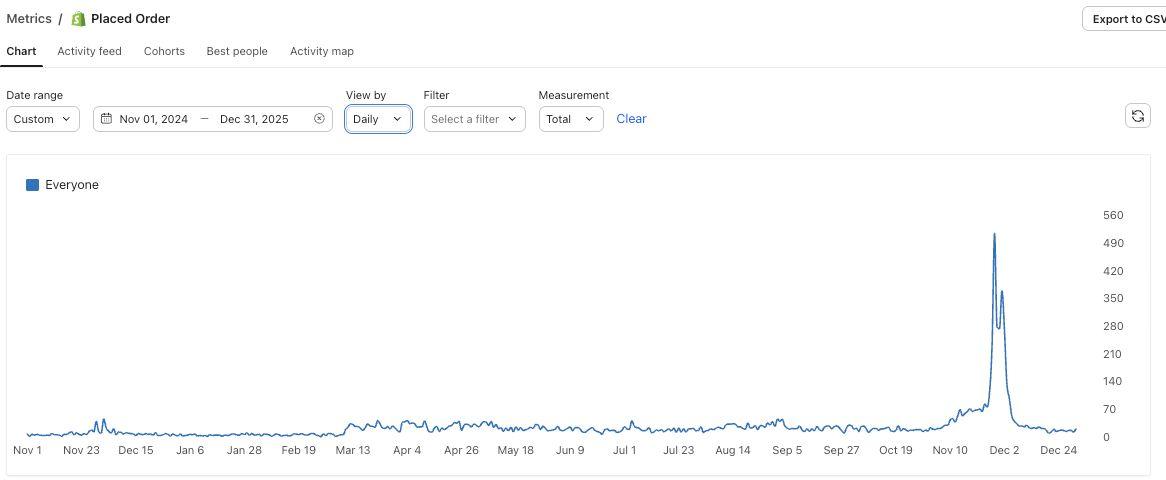
We also worked to grow email without relying on discounts for Scott Hawaii, a Hawaiian footwear brand founded in 1932. By focusing on product education, the brand story, and better timing, email-attributed revenue rose 121.6% year on year while the business grew 42.3%.
4. Make your flows match your offers
When a sale is running, your automated flows need to know about it. At Michael Gabriels, the automated emails didn't always match the promotions they were running. A shopper could see a Black Friday campaign, abandon their cart, and receive a flow email with no mention of the offer.
Before each event, we rebuilt the welcome series, abandoned cart, abandoned checkout, and post-purchase flows so customers saw consistent offers across campaigns and automations. It's extra work, but you don't want shoppers getting conflicting messages when they're close to buying.
5. Measure contribution, not just revenue
Email platforms report attributed revenue. That number doesn't account for discounts, product costs, fees, shipping, or returns. If you're comparing your own store with Amazon, compare what each channel actually contributes after those costs, including the same types of costs in both calculations.
Check your attribution window too. Klaviyo's default is 5 days. We've seen agencies stretch it to 20 or 30 days to make email-attributed revenue look much higher. However, that tells you nothing about profit.
Where to start
You can set up an email-only sign-up form with a second step that asks what shoppers want. Split your campaigns into buyers and non-buyers as soon as possible. Before your next peak, decide whether a product-level price drop can replace your sitewide discount code.
If you need layouts for those emails, our free Figma email template pack includes welcome, abandoned cart, and post-purchase designs. If you sell jewellery, our guide to email marketing for jewelers covers the category in more depth, and our ecommerce email marketing case studies show even more results.
About the author
Gavin Hewitson is the founder of In-box, a Klaviyo Master Gold Partner agency for ecommerce brands. Over five years, he and his team have worked with more than 500 ecommerce brands on email and SMS. See their results at in-box.com/case-studies, or download their free Figma email template pack.