By Naeela
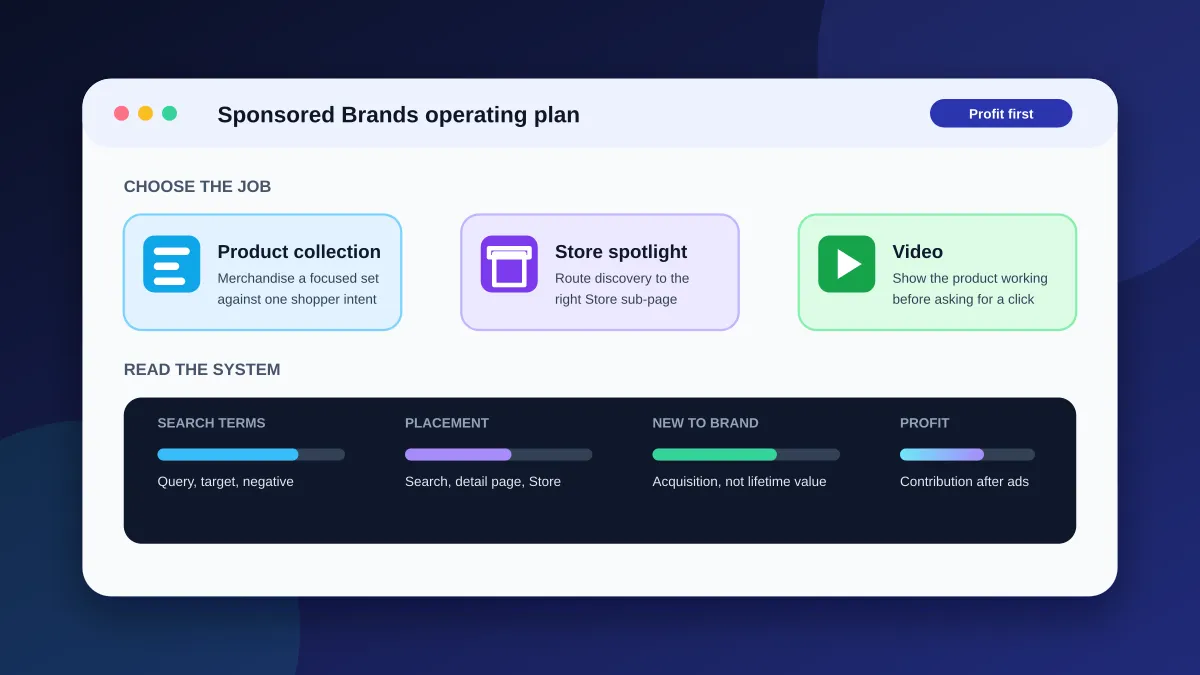
Amazon Sponsored Brands are paid display and video ads built for brand discovery on Amazon, with 3 core formats: product collection, Store spotlight, and video. The profitable way to use them is to give each campaign one job, match the creative to the destination, and measure search terms, placement, new-to-brand orders, and contribution together. They are not simply larger Sponsored Products ads.
Key Takeaways
- Sponsored Brands has 3 core formats: product collection, Store spotlight, and video.
- Store spotlight can feature up to 3 Store sub-pages, and the Store needs at least 3 eligible sub-pages.
- Sponsored Brands video can run from 6 to 45 seconds and may lead to a product detail page or Brand Store.
- New-to-brand reporting uses a 12-month purchase lookback, but it does not prove incrementality or lifetime value.
- Run a 4-week test with 1 campaign job, 1 destination, and 1 named profit threshold before scaling.
What are Sponsored Brands, and what are they not?
Sponsored Brands are customizable ads that can use a logo, headline, custom image, product collection, or video to introduce a brand and its products. Amazon says they can appear above, alongside, or within shopping results and on product detail pages. Some placements and objectives also reach the Amazon homepage. Clicks can lead to a product detail page, a Brand Store, or an eligible landing page, depending on the format and marketplace (Amazon Ads).
The first decision is to keep the ad types straight. A format cannot do a job it was not designed to do.
| Ad type | Main unit | Typical destination | Primary operating job |
|---|---|---|---|
| Sponsored Products | One advertised product | Product detail page | Capture product-level purchase intent |
| Sponsored Brands | Brand-led display, collection, or video | Product detail page, Brand Store, or eligible landing page | Create discovery, consideration, and catalog exploration |
| Sponsored Display | Display creative using retail or audience signals | Usually a product detail page | Reach or re-engage shoppers on and off Amazon where available |
| Amazon DSP | Programmatic display, video, and audio inventory | Varies by campaign | Build and measure broader audience journeys |
This distinction matters because teams often import Sponsored Products rules into Sponsored Brands. They copy a keyword list, add a headline, and expect the same conversion behavior. The shopper has been given a different choice: browse a collection, enter a Store, watch a product work, or click a single item.
That extra choice can help or hurt. If the creative promises "solutions for small kitchens" and the click lands on an undifferentiated Store homepage, you paid to make the shopper restart the search. More ad real estate did not create more relevance.
Who is eligible to run Sponsored Brands?
For most sellers, Sponsored Brands eligibility starts with a professional selling account and enrollment in Amazon Brand Registry. Vendors, agencies, and some authors can also qualify. Availability varies by country, advertiser type, category, and format, so the advertising console is the final account-level check (Amazon Ads eligibility requirements).
Brand Registry is not a box to tick five minutes before launch. The brand-to-ASIN relationship, logo rights, Store status, product eligibility, and creative policy all affect whether a campaign can be built and approved. If your enrollment or brand mapping is incomplete, fix that before debating bids. Our Amazon Brand Registry guide covers the ownership and enrollment work.
Product eligibility matters too. A registered brand does not make every product or claim ad-safe. Amazon applies sponsored-ad policies, restricted-category rules, local laws, and creative acceptance requirements. Review those rules for the marketplace where the ad will run. Do not rely on a campaign that passed review in one country as proof it will pass everywhere.
Which Sponsored Brands format should you choose?
Choose the format from the shopper's next decision, not from the asset you happen to have. Amazon's current guide identifies product collection, Brand Store spotlight, and video as the core formats (Amazon Ads Sponsored Brands guide).
| Format | Use it when | Destination logic | Main failure mode |
|---|---|---|---|
| Product collection | Several products answer the same query or use case | Send the click to a relevant Store page or eligible product collection | Mixing unrelated ASINs because they are bestsellers |
| Store spotlight | The Store has distinct, useful routes for a browsing shopper | Feature up to 3 eligible sub-pages | Sending traffic into weak or stale Store navigation |
| Video | Demonstration, comparison, fit, or use makes the product easier to understand | Choose a product detail page or Brand Store campaign where supported | Building around audio when video starts muted |
Product collection
Product collection is strongest when the products form a real answer set. Three sizes of the same storage system make sense. A water bottle, phone case, and unrelated seasonal accessory do not become a collection because finance wants all three to move.
Amazon can dynamically select relevant products from the landing page in some product collection campaigns. If you enable that option, keep the headline broad enough to remain true when the displayed products change. A product-specific claim beside a dynamically changing assortment is a preventable approval and trust problem.
Store spotlight
Store spotlight can feature up to 3 Store sub-pages. Amazon's guide says the Store must have at least 3 sub-pages, with a unique product on each, to be eligible. That is a technical minimum, not a merchandising standard.
Each tile should represent a route a shopper can understand in a second: "Travel sizes," "Sensitive skin," or "Starter kits." Labels copied from an internal catalog hierarchy are not navigation. If the Store cannot support three clear routes, improve the Store or choose another format.
Sponsored Brands video
Amazon's current creative specifications allow videos from 6 to 45 seconds. They autoplay when enough of the unit is on screen and start muted, so the product and benefit must make sense visually. The specs support product-detail-page campaigns and Brand Store campaigns, with placement and locale differences (Sponsored Brands video specifications).
Video is not automatically upper funnel. A six-second fit demonstration can answer a purchase objection more directly than a static banner. A glossy brand film can also earn attention without producing a qualified click. Judge the format by the decision it resolves.
Where should a Sponsored Brands click land?
The landing page should continue the promise with the fewest new decisions. Use a product detail page when one ASIN is the answer. Use a focused Store sub-page when the shopper needs a range, comparison, or category path. Use a broader Brand Store destination when discovery is genuinely the job.
Amazon's setup flow can present a Brand Store, product detail page, or new landing page depending on the chosen format and account. Do not assume every destination is available for every campaign. Check the console before approving creative.
Run this 3-part destination test:
- Message match: does the first screen repeat the product, use case, or range promised in the ad?
- Choice control: can the shopper understand the next action without reopening Amazon search?
- Commercial readiness: are the featured products in stock, correctly priced, eligible, and worth buying after ad cost?
The landing page is part of the ad economics. A beautiful Store that buries the advertised category can lower conversion. A product page with weak reviews or a broken variation can waste a strong video. Advertising cannot repair the system it hands the shopper to.
How should you use targeting and search-term reports?
Sponsored Brands supports keyword targeting and product targeting. Amazon's guide says a campaign uses one targeting type, while the broader account can use both. Keyword targeting matches broad, phrase, or exact keyword targets to shopping queries. Product targeting selects categories or specific products and can place an ad around those retail contexts.
A keyword is what you bid on. A search term is what the shopper actually used. That difference is where waste and opportunity become visible.
Review the Sponsored Brands search-term report on a fixed cadence. Promote qualified queries into controlled targets, add negatives for irrelevant patterns, and separate branded, category, and competitor intent so one result does not hide another. Amazon also provides Search Term Impression Share reporting for eligible Sponsored Brands activity, which helps show how often an advertiser appeared for a term relative to total eligible Sponsored Brands impressions (Amazon Ads SIS report).
Community evidence explains why this work cannot be skipped. In a 2024 Amazon Seller Forums thread, sellers reported sharply mixed Sponsored Brands results and argued over match behavior, exact targeting, and the value of video. Those are anecdotes, not benchmarks. They do show a recurring operating failure: teams compare ad types before separating target, query, creative, and destination (Amazon Seller Forums).
Independent operator guides reach a similar practical conclusion. SellerMetrics distinguishes keyword targeting from the query that triggered the ad and warns that automated settings can be confusing. It sells advertising software, so its advice is commercially affiliated, but the workflow distinction is useful and consistent with Amazon's reports (SellerMetrics).
How do placements and bidding work without guesswork?
Sponsored Brands can use cost-per-click, cost per thousand viewable impressions, and, for eligible reserve share-of-voice campaigns, fixed upfront pricing. The available model follows the campaign goal and format. Do not paste Sponsored Products automated-bidding advice into Sponsored Brands and call the account improved.
Amazon supports bid controls and, in eligible campaigns, adjustments for placements or audiences. Its current setup guidance lets advertisers choose an increase or decrease for a placement adjustment. The important point is not a universal multiplier. It is the relationship between the base bid, the adjustment, the click value, and the campaign's job (Amazon Ads campaign setup).
Start from economics. If an order produces $24 of contribution before advertising and the landing experience converts 1 order from every 8 paid clicks, the break-even click value is $3 before you add a safety margin for returns, volatility, and measurement error. Replace every input with product-level data.
Then read placement separately. Top-of-search, other shopping-result, product-page, and video inventory can behave differently, while exact labels and controls can vary. If the report does not isolate a placement cleanly, do not manufacture precision from the blended campaign average.
Sponsored Brands video also has its own placement and auction, according to Amazon. That is another reason not to interpret it as a static Sponsored Brands banner with motion. Keep format-level and placement-level performance visible.
Our broader Amazon PPC operating playbook shows how to turn reports into controlled changes. The rule here is simpler: change one economic lever at a time, record the reason, and give the test enough qualified traffic to teach you something.
How should you measure new-to-brand performance?
New-to-brand metrics classify orders and sales from shoppers who had not bought from the advertised brand on Amazon during the prior 12 months. The suite can include new-to-brand orders, sales, units, and their share of the reported total. It helps distinguish acquisition from repeat purchase within Amazon's attribution rules (Amazon Ads new-to-brand metrics).
Do not turn that label into a claim it cannot support. New-to-brand does not prove the ad caused an incremental customer. It does not measure the shopper's off-Amazon history. It does not tell you whether the first order will produce a second profitable order.
Use 4 views together:
- Acquisition: new-to-brand orders, sales, and cost per new-to-brand order.
- Traffic quality: search terms, placement, click-through rate, and landing-page behavior.
- Retail outcome: ordered products, conversion, returns, stock, price, and review health.
- Economics: contribution after ad spend, not ROAS alone.
Amazon added Brand Store page views as a Sponsored Brands metric in 2025 for campaigns linked to a Store. It connects ad activity to attributed Store pages viewed, but a page view is not an order. Use it to diagnose whether a Store campaign creates exploration, then follow the money into ordered products and contribution (Amazon Ads launch note).
ROAS is not a business model. A campaign can show healthy attributed sales while promoting low-margin products, accelerating a stockout, or harvesting demand the brand already owned. Our product-level contribution guide explains the calculation that should sit beside ad metrics.
Where does ALFI fit, and where does it not?
ALFI is built for established brands generating $1M+ a year on Amazon and $1M+ DTC brands ready to make Amazon a serious channel. We cap the roster at 18 clients so Naeela and a senior team can stay close to strategy, delivery, and the weekly decisions that move profit.
We do not accept PPC-only mandates. Sponsored Brands touches creative, Store architecture, catalog, inventory, pricing, reviews, unit economics, and reporting. Accepting responsibility for profitable growth while controlling only the bid would be commentary without accountability.
That boundary makes us a poor fit for early-stage sellers, teams buying isolated campaign setup, leaders choosing mainly on price, or brands that want a large rotating bench. A specialist or strong internal media lead can be the better choice when the rest of the Amazon operation already has clear owners and shared economic truth.
For the right fit, ALFI owes senior judgment, continuity, candid recommendations, and the willingness to slow spend when the retail system is not ready. The client owes access, reliable cost data, inventory truth, and willingness to act on hard recommendations. See how our Amazon growth services connect advertising to the rest of the account.
What are the 3 main Sponsored Brands formats?
The 3 core formats are product collection, Store spotlight, and Sponsored Brands video. Product collection presents a relevant product set, Store spotlight routes shoppers to selected Brand Store sub-pages, and video demonstrates a product or brand story. Exact creative and destination options can vary by marketplace and account.
Do you need Amazon Brand Registry for Sponsored Brands?
Most professional sellers need enrollment in Amazon Brand Registry and an eligible brand-to-product relationship. Vendors, agencies, and certain authors may also qualify under Amazon's marketplace rules. Eligibility can still vary by country, category, format, and product, so confirm the available Sponsored Brands options in your advertising console.
Can Sponsored Brands link directly to a product page?
Yes. Eligible Sponsored Brands campaigns can send shoppers to a product detail page, while other formats can lead to a Brand Store or eligible landing page. The correct destination depends on the format and shopper job. Use the page that continues the ad promise with the fewest unnecessary choices.
What does new-to-brand mean in Sponsored Brands reporting?
New-to-brand identifies attributed orders or sales from shoppers who had not purchased from the advertised brand on Amazon in the previous 12 months. It is an acquisition indicator, not proof of an incremental sale or customer lifetime value. Read it beside search terms, conversion, ordered products, and contribution.
Should Sponsored Brands use the same bids as Sponsored Products?
No automatic rule makes the same bid correct. Sponsored Brands can use different formats, destinations, placements, auctions, and campaign goals. Calculate click value from product contribution and conversion, then inspect search terms and placement. Sponsored Products history can inform a starting hypothesis, but it does not replace a Sponsored Brands test.
What to do this week
- Export the last 4 weeks of Sponsored Brands campaign, search-term, placement, and new-to-brand data.
- Label every campaign with 1 job: defense, category discovery, product education, or Store exploration.
- Check that each creative promise matches its first landing-page screen and in-stock product set.
- Split branded, category, and competitor intent where blended results hide the decision.
- Set a product-level break-even click value and contribution threshold before changing bids.
- Choose 1 creative or destination variable to test for the next 4 weeks, then record the decision and owner.
The work is not finding a universal bid trick. It is keeping creative, query, destination, retail readiness, and profit connected long enough to make a clean decision.